“To honour a master is a gesture that says more about the person who pays tribute than the one who receives it.”
These words by Wael Farouq, Director of the Arabic Cultural Institute, set the tone for the day, foregrounding the enduring value of a cultural legacy that lives on through the work of those who carry it forward. Gratitude, after all, extends beyond commemoration. It is a form of fidelity: a commitment to embracing an intellectual legacy and carrying it into new contexts, opening up possibilities that might otherwise never have been imagined.
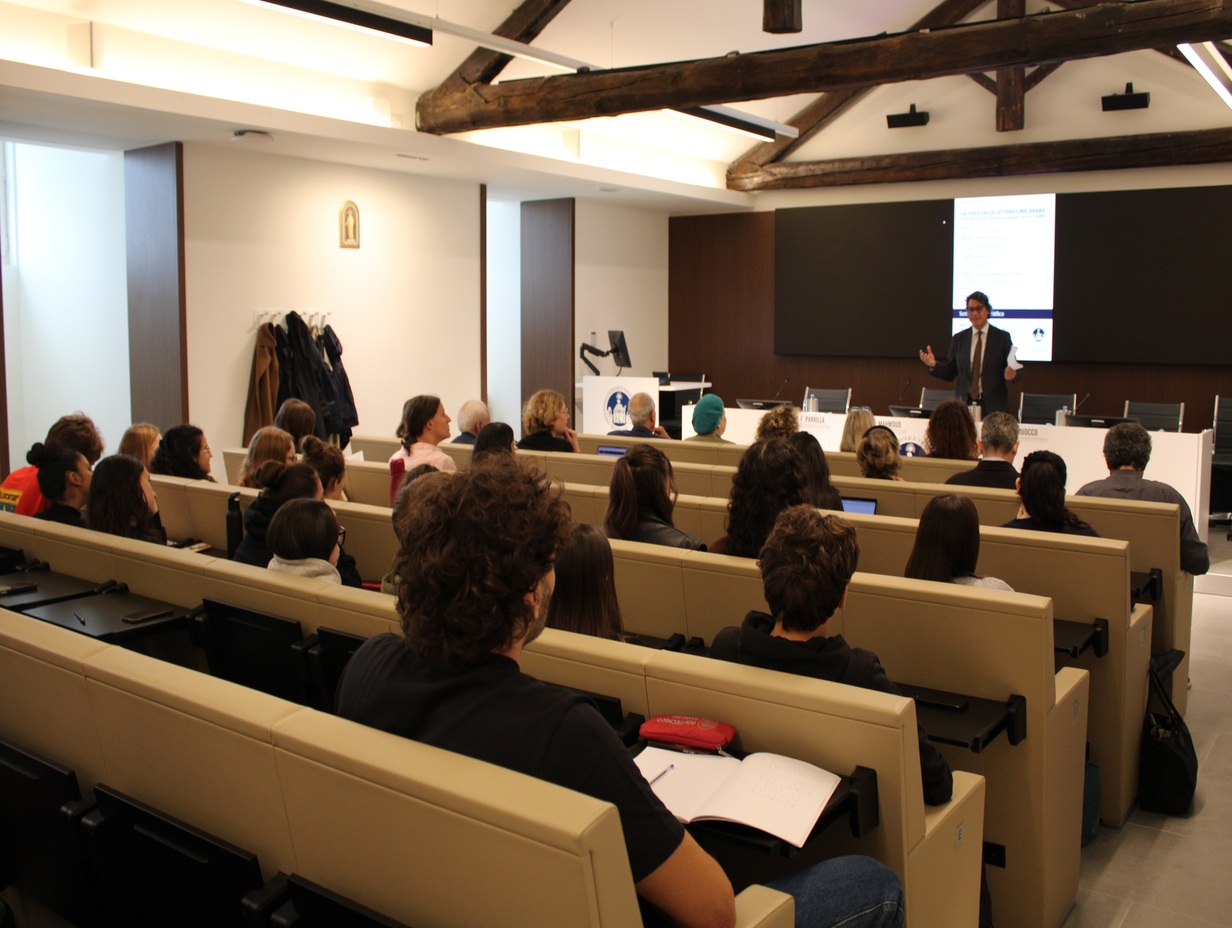
It was in this spirit that The Voice of Arabic Literature: A Study Day in Honour of Isabella Camera d’Afflitto took place. The event was more than a retrospective celebration of a distinguished academic career. It offered an opportunity to reflect on how a lifelong passion can transcend the individual who nurtures it and become a source of shared knowledge.
The morning session, devoted to Isabella Camera d’Afflitto and the study of Arabic literature, brought together Gonzalo Fernández Parrilla of the Universidad Autónoma de Madrid, Monica Ruocco of the University of Naples L’Orientale, and Hussein Mahmoud of Badr University in Cairo. The afternoon turned to the translation of Arabic literature in Italy, featuring contributions from Simone Sibilio of Ca’ Foscari University of Venice, Naglaa Waly of the University of Turin, and Manuela Elisa Bibiana Giolfo of IULM University in Milan.
The programme continued with the presentation of the volume Letterature arabe dalla Nahḍah al nuovo millennio (Arabic literatures from the Nahḍah to the new millennium), presented by Sobhi Boustani of the Institut National des Langues et Civilisations Orientales in Paris and Paola Viviani of the University of Campania Luigi Vanvitelli. Spanning two centuries of literary and cultural history, from the Nahḍah - the Arab cultural renaissance - to the new millennium, the volume is the fruit of an extensive intellectual journey. Rather than offering a definitive conclusion, it opens a new threshold, providing the tools and raising the questions that will enable others to continue the exploration. The day concluded with contributions from Isabella Camera d’Afflitto and Wael Farouq.
The work of Isabella Camera d’Afflitto invites us to move beyond the labels through which we so often seek to define entire peoples and to discover in their stories questions, desires and hopes that are also our own. Translation, in this light, assumes a significance that extends far beyond philology: it becomes an ethical undertaking. Its purpose is not merely to make a literary tradition accessible, but to create the conditions in which it can be encountered, understood and critically engaged with.
Perhaps it is precisely in this capacity to shape the future that the deepest meaning of this tribute resides: in the possibility of passing a passion from one generation to the next, of allowing the work of a lifetime to open up new paths, and of enabling one voice to awaken many others. For a master’s legacy endures not only in the memory of what they have accomplished, but also in what others, inspired by their example, will go on to achieve - and in the courage to venture further still.